
Skin surgery is a
surgical discipline.
We treat it as one.
Most skin lesions in this city are removed by whoever is free that afternoon, with a laser, and never sent for testing. That is not a shortcut. It is the destruction of the only tissue a pathologist could have examined.
What we operate on.

Anything that could be more than cosmetic. Assessed first, excised second.
3 procedures →Acne, surgical, burn, trauma. Improvement is quantified before it is attempted.
3 procedures →Nail unit, earlobe, and the reconstructive work most clinics refer away.
2 procedures →Every specimen goes for testing. Every one.
Not on request. Not if you ask. Not if the lesion looks suspicious enough to bother. Every piece of tissue removed in this clinic is sent for histopathology, and the report reaches you whether or not the finding is significant.
Most of them come back entirely benign, and that report is worth having in your file. The few that do not are the whole reason the rule exists, and by the time a lesion is obvious enough to test selectively, you have already lost the months that mattered.
- ✕Lasering a pigmented lesion that has not been assessed
- ✕Cauterising a mole because it is faster than excising it
- ✕Skipping the report to keep the fee down
- ✕Telling you it is fine without a pathologist having looked
If another clinic has removed a lesion from you and cannot produce a histopathology report, bring what you have. We will tell you what it means and what, if anything, should be done now.
Every procedure,
with a published protocol.
Not a service list. For each one: what is actually done, in what order, and what the realistic ceiling on the result is. If a procedure has a recurrence rate, it is written on the page rather than discovered afterwards.

Mole & Naevus Excision
Full-thickness excision with clear margins, closed in layers along relaxed skin tension lines.
Protocol →Cyst, Lipoma & Skin Tag Removal
Complete capsule removal, not deroofing. Deroofing is why they come back.
Protocol →Suspicious Lesion Assessment
Dermoscopy and, where indicated, biopsy. Time matters more than convenience here.
Protocol →Acne Scar Revision
Scars are typed before they are treated. Ice pick, boxcar and rolling need different instruments.
Protocol →Surgical & Trauma Scar Revision
Excision and reorientation so the scar falls along a line the face already has.
Protocol →Keloid Management
Excision alone recurs. It is the adjuvant protocol that holds the result.
Protocol →What we will not
do to your skin.
Published, because the things a clinic refuses tell you more than the things it advertises.
- 01Lasering a pigmented lesion that has not been assessed
It destroys the only tissue a pathologist could have examined. We assess first, always.
- 02Excision without histopathology to save time or cost
Every specimen goes for histopathology. There is no version of this where it is optional.
- 03Surgery on active or spreading vitiligo
Stability must be documented over twelve months. Operating earlier produces new patches at the donor site.
- 04Single-session promises on mixed acne scarring
Ice pick, boxcar and rolling scars need different instruments. Anyone promising one sitting has not typed your scars.
- 05Keloid excision without an adjuvant programme
Cutting out a keloid and doing nothing else has a high recurrence rate. If you cannot attend the follow-up programme, we will not start.
- 06Same-day procedure at the first consultation
Unless it is clinically urgent, you go away with a written plan and a cooling period.
Revision improves
a scar. It does not
remove one.
Any clinic promising removal is describing something that does not exist in dermatology. What does exist is a mark that is smaller, flatter, better oriented, and that the eye stops going to. Here is what each scar type realistically gives.

| Scar type | What is actually done | Realistic improvement | Sittings |
|---|---|---|---|
| Ice pick | TCA CROSS, or punch excision where wide | 50 to 70 percent | 3 to 5 |
| Boxcar | Punch elevation or excision, then resurfacing | 40 to 60 percent | 3 to 4 |
| Rolling | Subcision with support to prevent re-tethering | 50 to 70 percent | 2 to 4 |
| Hypertrophic | Intralesional protocol, pressure therapy | Variable, staged | Programme |
| Keloid | Adjuvant protocol first, excision second | Recurrence is the risk, not the result | Programme |
| Post-surgical linear | Excision and reorientation to tension lines | Depends entirely on tension | 1 to 2 |
Ranges reflect clinical practice and are not a commitment for any individual. Response varies with skin type, scar age and tension.
The same surgeon,
the same standard.
Skin surgery here is not handed to a junior because it is smaller than a transplant. Dr. G. Revanth, MBBS DDVL DNB, is a dermatologist by training. Lesion assessment, dermoscopy, excision, closure and specimen handling are all on his list, and all of them are on the published delegation table.
Read the delegation table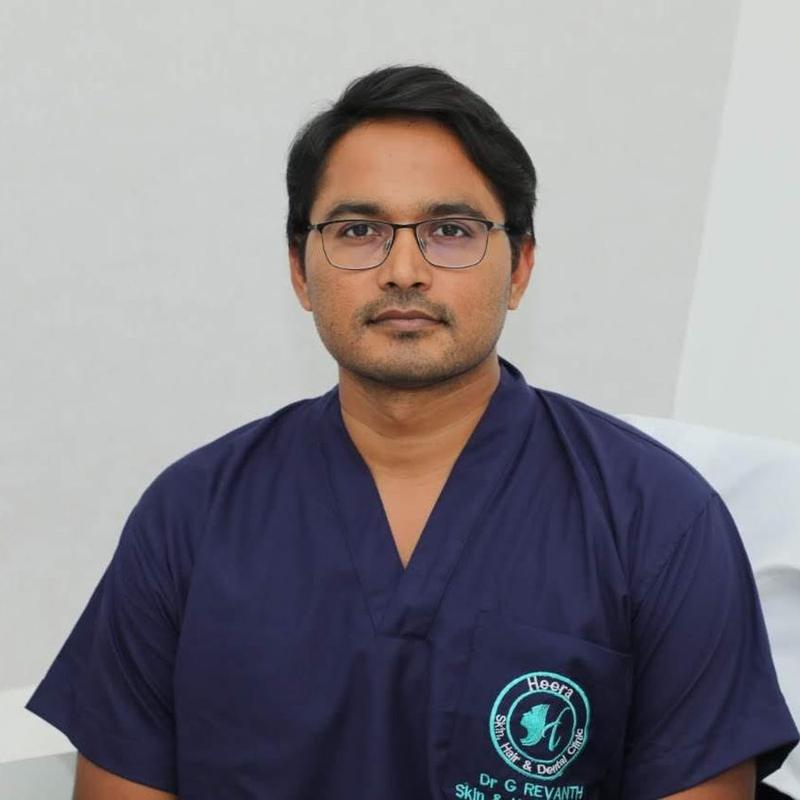

The lesion is not
going to assess itself.
Two minutes on the assessment tells you whether this is routine, whether it should be looked at this month, or whether it should not wait a week. It costs nothing and it does not put you on a call list.
Dermatosurgery at this clinic covers four groups: lesion and oncologic, scar and reconstruction, pigment and vitiligo, and structural and nail. Nine procedures are performed, each with a published protocol, a realistic ceiling and a recovery timeline. Every excised specimen goes to histopathology, whether or not the lesion looked suspicious, and vitiligo surgery is offered only on disease documented stable for twelve months.
Questions people actually ask
Is every mole that is removed sent for testing?
Yes. Every excised specimen at this clinic goes to histopathology, whether or not the lesion looked suspicious. Most come back entirely benign and that report is worth having in your file. By the time a lesion is obvious enough to justify testing selectively, the months that mattered have already gone.
Will removing a mole leave a scar?
Yes. Any full-thickness excision leaves a linear scar, and the honest question is how good a scar rather than whether there is one. Placement along skin tension lines, layered closure, six weeks of tension protection, daily silicone and daily SPF 50 are what decide the difference between a fine line and a wide one.
How much can acne scars actually be improved?
A realistic target is a meaningful reduction in shadow and texture, not smooth skin, and it is quantified against your baseline photographs before treatment starts rather than promised as a percentage. Rolling, boxcar and icepick scars each need a different technique, so a plan is usually a sequence of three to six sessions six to eight weeks apart.
Can a keloid be removed?
Excision alone recurs in the large majority of keloids and often returns larger, so it is only offered here inside a combined protocol with intralesional therapy, pressure and silicone. The realistic aim is control and flattening with the symptoms gone, over a minimum of twelve months of follow-up, not disappearance.
Read before you decide
Is my mole dangerous? The ABCDE check
Five features that move a mole from something you dislike to something that should be examined this week.
Read →Mole removal: excision, testing, and the scar
Three things decide how this goes, and only one of them happens in theatre.
Read →Keloid treatment: why cutting one out usually fails
A keloid is a scar that did not know when to stop. Excision alone recurs in most cases, and often comes back larger.
Read →Scar revision: trading a scar for a better scar
Revision does not remove a scar. It replaces it with one that was planned rather than inflicted.
Read →